Would a tanto trade‑in program encourage upgrades within your product ladder?
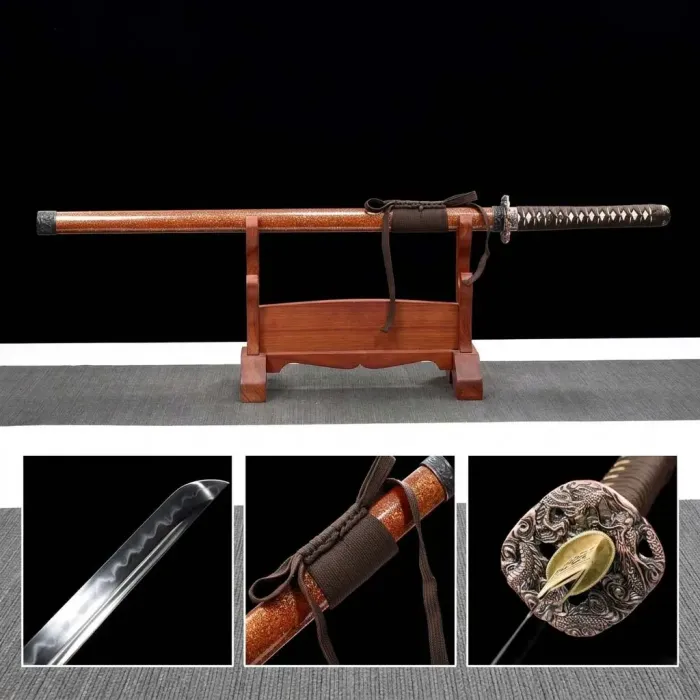
An heritage oriental sword serves as a beautiful showcase of talent, but imagine you aim to to demonstrate your exclusive aesthetic? Altering your sword is a enriching journey, allowing you to forge a truly rare piece. From the handle wrapping and clasp to the tsuba design and cutting motif, each segment offers a chance for tailored look. This survey delves into the world of katana customizations, providing guidance for both learners and seasoned enthusiasts aiming to form their legacy on the long-standing art of the samurai.
1060 Steel Katanas: The Beginner's Real Skill
For those prepared to embark on the enriching journey of martial arts involving swords , 1060 steel katanas furnish an remarkable entry point. This particular grade of tool steel balances a suitable blend between price and efficiency . While below hard as leading steels, 1060 allows for a manageable level of blade refinement , making it fitting for trainees to improve the fundamentals of katana upkeep and admire the allure of classic Japanese weaponry. It’s a first-rate choice for cultivating experience without the pecuniary burden of more advanced steels.
T10 Steel Swords : Finding Quality and Cost
Assisting practitioners seeking an authentic blade experience without shattering the wallet , T10 fabrication katanas represent a inviting option. These tools offer a noticeable improvement in durability compared to lower-grade alternatives, exhibiting decent edge retention and fair flexibility for rudimentary slashing techniques. While not rivaling the eminent characteristics of advanced steels like T100 or folded material , T10 provides a worthwhile blend of ability and affordability , making them a popular choice for apprentices and those on a controlled revenue .
Surpassing the Edge : Customizing Your Weapon's Accessories and Hilt
Although the polished metallic edge is undeniably the core point of a katana, truly enhancing its beauty lies in the detailed customization of its accessories and grip . This operation allows craftsmen to demonstrate their unique design . Reflect on the vast possibilities: menuki - decorative embellishments that add visual charm ; the hamon shields – often delicately sculpted ; the tsuka heart itself, wrapped in conventional ito yarn; and the fusa cap, which can be created from various materials like gold or cartilage .
- Decide on motifs that match with you.
- Investigate with various elements .
- Concentrate on excellence for a durable effect .
The Fascination of the Katana: Origins, Mastery, and Material
Each nihonto exhibits a unique allure, steeped in generations of Far Eastern history and custom . More than merely a device of skirmishing, it's a representation of the knight ethos – a fusion of prowess and self-control . Its growth spanned plentiful generations, with early swords evolving into the sleek curvature and precise edge we recognize today. The creation involved is truly amazing , requiring eons of apprenticeship to attain . The process involves a complicated folding of pure iron , creating layers that enhance the cutting edge’s flexibility and carving ability. Numerous schools of smithing arose , each with their unique secrets and approaches for achieving the supreme proportion and crispness - a truly laborious pursuit.
- Initial Katana models
- The significance of the cutting armament in soldier culture
- Established smithing methods
Deciding the Best Steel for Your Bladed Weapon Project: 1060 vs. T10
Deciding on the ideal steel is vitally important for any cutlery project, and the conclusion between 1060 and T10 can be intricate. 1060 is a widely used American alloy, offering a reasonable balance of durability and robustness, allowing it fairly easy to temper. However, T10, a originating from Japan steel, generally boasts superior wear resistance and can perhaps achieve a elevated end hardness, although it can be significantly complex to operate and requires exact heat tempering. Consider your skillset and desired goals: for a inexperienced, 1060 may be a clearer basis, while the proficient smith might favor the increased details of T10.
- Manageability of Managing
- Surface
- Final Toughness
Unleashing the Power: High-Level Katana Modification Methods
Excelling in the craft of sword improvement extends far beyond basic grinding. Serious practitioners are now exploring advanced techniques to truly discover a blade's hidden potential. This requires intricate work with the hamon, utilizing specialized resources for differential heat treatment and carefully selecting the configuration of the guard to optimize balance and performance. Beyond purely functional refinements, artisans are increasingly focused on creating unparalleled aesthetic magnificence, through complex incising and layered varnishes that truly transform a katana into a magnum opus.
Shaping Rough Steel into Perfection: Making a 1060 Sword
The journey starts with average 1060 metal , a strong material far away the deluxe katana it will transform . Proficient bladesmiths utilize a sophisticated process of layering and forming the raw steel, repeatedly burning it and flattening it to discard impurities and build a uniform grain structure. This tiring process, often lasting for periods , builds the fundamental toughness and suppleness characteristic of a standard Japanese weapon . Supplementary heat treatments , including exact hardening and curing , are critical katana to achieve the specific proportion of sharpness, durability and grace .- Combining: Diminishes impurities and creates grain structure.
- Fabricating: Shapes the steel into the initial blade form.
- Annealing: Establishes the final hardness and flexibility.
The Persistent Magnetism of the Katana: Thorough Examination of Alloy and Modification
That long-standing katana survives a striking symbol within Japanese tradition , its attraction far outstripping mere military gear. Forged from a special steel and sometimes featuring intricate designs , the method of creation itself is a respected art. Beyond the central craftsmanship, the ability to reshape a katana - from the temperation to the hilt wrapping and guard - enables for a perfectly individual statement for both admirers and wielders alike. This fusion of long-established steelwork and boundless personalization produces the katana's continued fame across the earth .
